Un-Squeeze
Join the UN-SQUEEZE Launch Crew
Come aboard for early access: a free preprint copy, bonus resources, and an exclusive Q&A with me. Share your reaction with me before launch day!
Unsure about joining? Read a sneak preview.
Preface
Are you navigating transformations where no one seems to have the complete picture and change is happening at breakneck speed? This book is written for you. Are you redesigning workflows to enable new service delivery models or weave in rapidly evolving technology like AI, all while your team is already stretched thin? This book is for you.
Early in my career, I experienced fulfillment and success co-designing workflow changes and IT systems directly with the people impacted by them. But as my career progressed, the nature of change shifted. Change grew in scope and complexity. Relationships across IT and operations fractured. Schedules left almost no time to explore or design. People grew tired and cynical.
I lost heart as I watched epic, enterprise-level change fail. Organizations tried to force new systems into old ways of working, burning through time, money, and sometimes people. The common thread was always the same: leaders and their operations staff seemed too busy to get involved. Traditional change management methods, such as endless surveys, massive document reviews, and grueling focus groups, demanded far more energy than busy people could spare. So, leaders pushed ahead blind, exhausting themselves trying to overcome the inevitable resistance to change.
I hit my breaking point. I could not keep implementing change this way, causing myself and others so much needless strain and not even achieving good results. There had to be a way to successfully co-design complex change within the tight constraints of heavy operational demands.
I have always been a visual person. Give me a map and I can understand the route in seconds. Tell me how to get there and I won’t remember past the second turn. So I decided to experiment with a time-pressed, budget-constrained client to see if we could create simple visual models to map the scope and impact of workflow and behavior changes. The results were striking. People jumped in, gave clear insights, and spotted critical gaps all within short meetings.
But the success was inconsistent. Some visual models pulled people in while others pushed them away. Why?
That question drove me to pursue a PhD. I wanted to solve one specific puzzle: How can we reduce the mental effort of understanding and designing new ways of working using visual models? I dove deep into research on visual cognition, organizational dynamics, and how our brains handle change. Then, I put that research into action with three healthcare teams who were stuck trying to figure out their own workflow and behavior changes.
I discovered something entirely unexpected. Yes, time and communication tools were big challenges, but the true roadblock to co-design was lack of hope. The people I was working with simply didn’t believe they could design something that would work for everyone. They had tried before, only to end up stuck in conflict or creating solutions with holes that made some of their jobs harder.
Together we experimented with a process to design and activate change, anchored by simple visual tools that everyone could easily understand. To each team’s surprise, they were able to collectively design successful change that benefited their patients and, most importantly, restored their hope.
That is why I wrote this book. I wrote it to give you, and your teams, hope and belief in your own capability to collaboratively bring about change. If you are feeling the squeeze of expectations, time and energy, this book is for you.
I want you to believe there is a better way. A way that isn’t too hard. A way that fits into busy schedules and doesn’t overload people. A way that empowers everyone to provide critical insights and proudly own the changes they build.
Come on a journey with me through the pages of this book. You will gain new mental models, practical tools and a much clearer perspective of the way ahead.
When you un-squeeze yourself and your team, you can lead change with less stress and greater impact.
Introduction
Squeezed
Mike snapped his laptop shut, his teeth clenched, a frown darkening his face as he strode out of the building to his car. He should have been celebrating a career dream come true, but it was starting to feel a lot more like a nightmare.
Two floors up, Rachelle let out a heavy sigh as she dropped her throbbing head into her hands. She should have been celebrating an imminent career success, not battling an invasive feeling of dread.
Mike had been looking forward to cheering on his daughter at her soccer game after work. But now he was biting back his frustration. A year ago, he had joined this insurance company as a senior manager, earned his team’s trust, and helped them tackle their toughest challenges. He was proud of their progress, loved his job, and treasured every moment of family time. Yet disruption loomed, fueled by talk of a new AI-powered system poised to upend operations and customer interactions. Earlier that day Mike’s boss, Rachelle, had dropped a bombshell. She told him he was expected to lead the implementation of this transformation, and his shot at a future promotion hung on his success.
At first he was excited.
But there was a twist.
Mike was still in the dark about the company’s new AI strategy. Months ago, he had provided an overview of his department’s processes. But since then there had been nothing. He wasn’t included in the strategic planning, and his meeting with Rachelle made one thing painfully clear: There was a gaping divide between the high-level vision and the practical realities his team faced every day. It was unclear what operational goals this strategy was expected to achieve, and Mike had no clue how this transformation would reshape daily routines, team dynamics, or workloads.
Mike had experienced sweeping organizational changes before. They were chaotic, confusing shifts that left operations in disarray for months. But this time, it was different. This time, he was the one expected to lead the charge. He got in his car and slammed the door shut. He punched the steering wheel, his thoughts a storm of anger and disappointment. Instead of the excitement he’d hoped to feel about this opportunity, his mind swirled in frustration, looping around how unprepared he felt. How could he guide his team through this when he was starting out blind?
Rachelle’s words echoed in his mind, “I want you to take center stage at the upcoming project kickoff event to rally the staff. They trust you.” However, Mike knew the questions from his management team would be coming, and he didn’t have the answers they needed. As he peeled out of the parking lot, angry questions raced through his mind. How could he ensure this transformation wouldn’t become a train wreck? How could he maintain his team’s trust and confidence? How could he keep the mounting workload from stretching him too thin? What if he couldn’t get his department on board? Worst of all, what if this derailed his career?
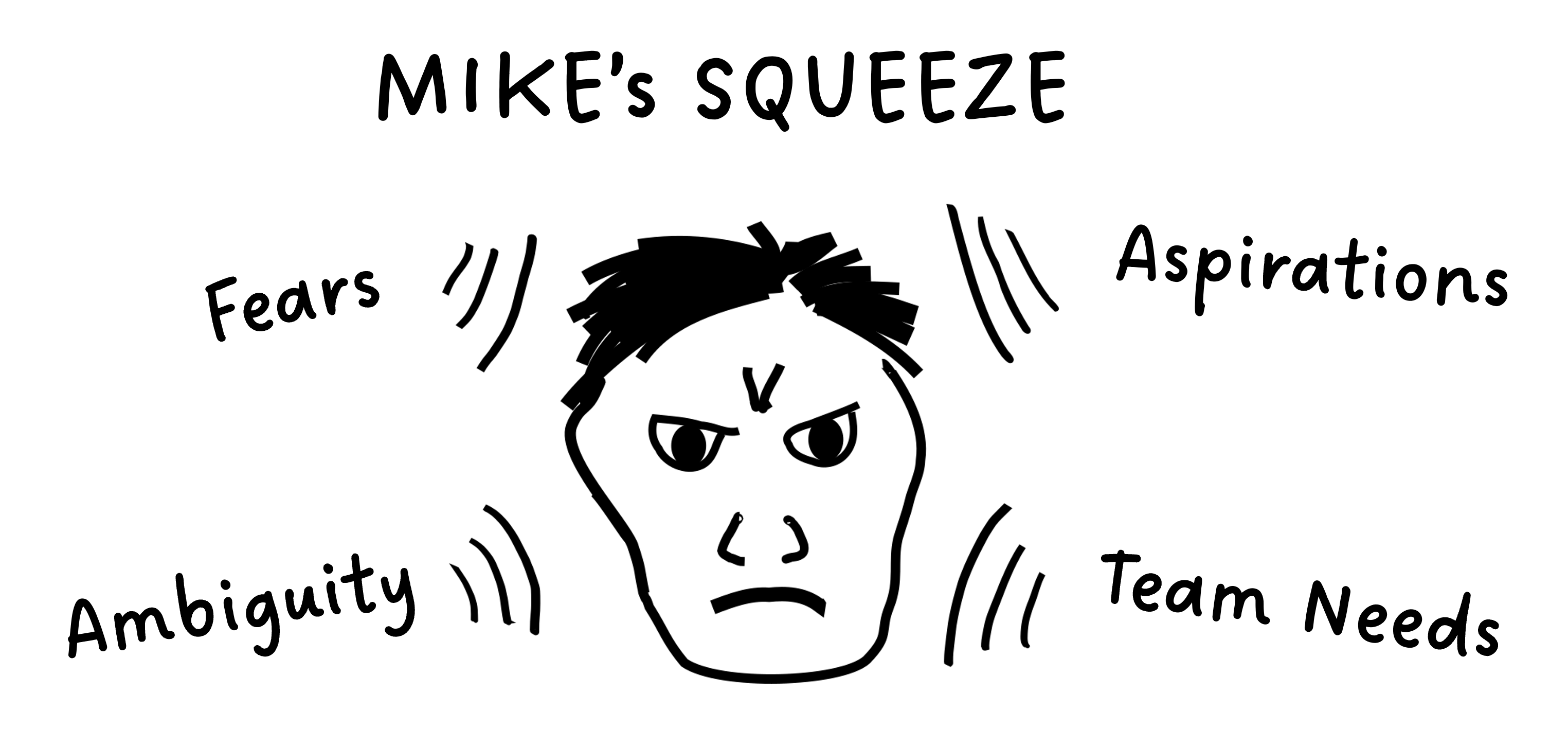
Caught between wanting to embrace the challenge and fearing he was doomed to fail, Mike felt the squeeze. He felt trapped, frustrated, and completely alone.
Rachelle, recently promoted to VP, was grappling with her own share of challenges. Her boss, Jac, the energetic and sharp-eyed COO, was known for his big ideas and decisive moves. He was thrilled with Rachelle’s stellar leadership on a high-stakes project to onboard their largest client group yet, a project she’d been guiding to resounding success. Buoyed by her performance, Jac handed her the reins of the company’s AI-powered digital transformation, a task as monumental as it was uncertain.
Jac was a steadfast supporter of Rachelle, coaching her and giving her the space to grow. He was a master at expanding the business but had always been on the sidelines of any significant digital transformation. Rachelle valued his mentorship but couldn’t shake her doubts about his ability to steer such an ambitious technological change. She had experience implementing AI in fraud detection, but integrating AI into customer service and operations workflows was uncharted territory, for both her and Jac. The thought of unknown risks and hidden obstacles gnawed at her confidence, infiltrated her thoughts and dreams, eroded the calm demeanor on which she prided herself.
Adding to the strain, the client onboarding project was still consuming much of Rachelle’s time, leaving her with little capacity to get a solid grasp on the AI transformation. The director of information systems and his team had done a commendable job outlining the technical options and requirements. But the impact on business operations remained a murky puzzle with no clear plan to solve it. All this fed Rachelle’s unease. If there was one thing she couldn’t stand, it was uncertainty. Rachelle thrives on clarity, on knowing exactly where she was headed and mapping every step to get there. Now she felt squeezed between Jac’s towering expectations, the fog surrounding the transformation’s impact, and the tight constraints on her time.
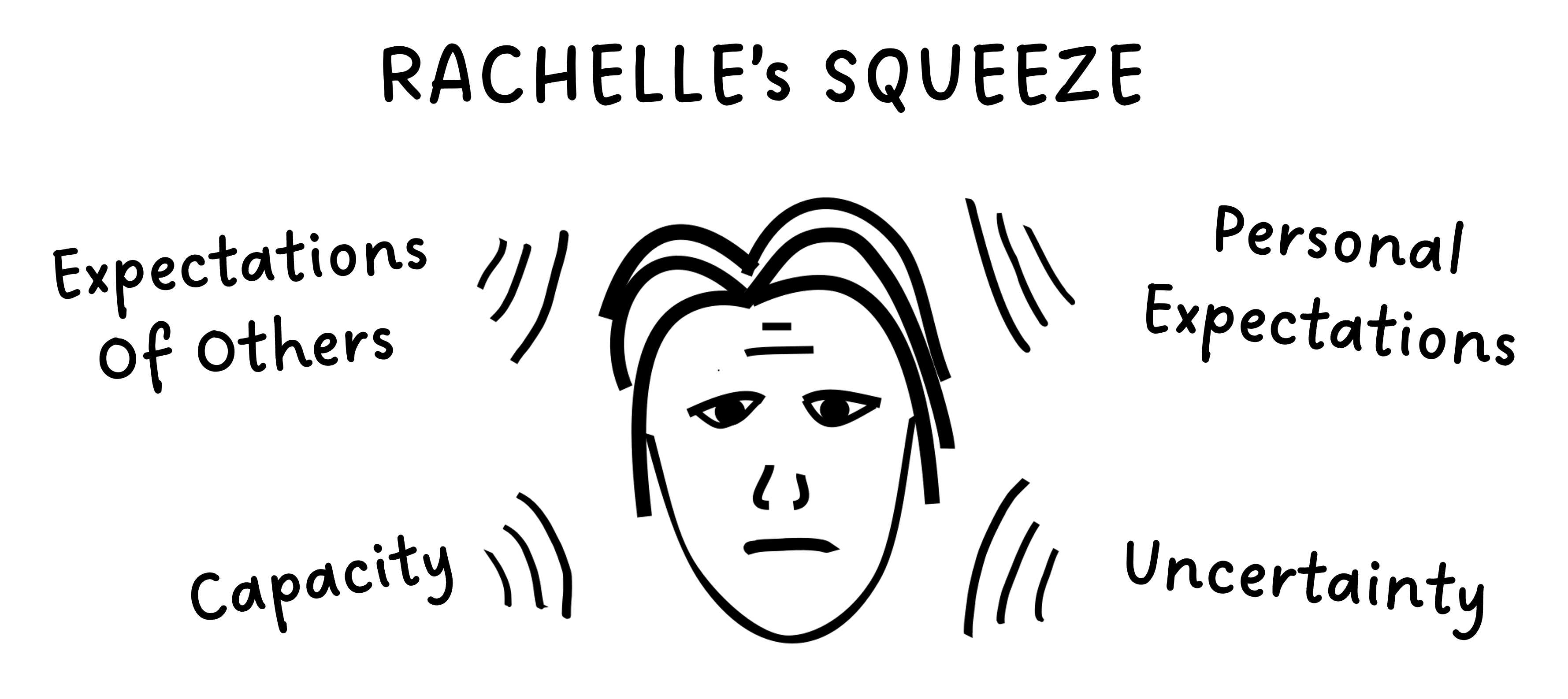
The Dire Need to Un-Squeeze
In the midst of every organizational transformation lies a familiar squeeze: the clash between ambitious goals and the gritty realities of daily work. As the pace of change accelerates, fueled by rapid technological advances like AI and shifting cultural expectations, the pressure only mounts. Perhaps you’re a manager or leader caught in these turbulent winds, feeling the strain as expectations collide and constraints close in from every side.
When strategic goals, team needs, personal expectations, and the limits of your capacity collide, it’s no wonder navigating it feels overwhelming. I’ve worked with large organizations, small businesses, senior leaders, and middle managers, and while the scope of the squeeze may vary, the core challenge is universal. Many leaders, including me, have pushed themselves to the brink. We battle endless crosswinds of demands to keep everyone focused, motivated, and productive, all while trying to manage the constant churn of change.
You want to engage and energize your people, but it feels impossible with the time and energy you have. Meanwhile, the dynamics within your team add to the chaos and resistance. The overeager ones are charging off in different directions, leaving a trail of confusion. The cynics are spreading rumors, souring every effort you make to rally the team. Others are simply overwhelmed, caught between winding up their anxiety and lying low, hoping the storm passes by them.
So you fall back on the classic top-down approach: Gather a small group, decide on the changes, train everyone, and launch. But here’s the catch: There’s no way a handful of people can grasp all the nuances of daily work or foresee how complex changes will ripple through the organization. Critical details are missed, and what seemed like a solid plan on paper begins to unravel in practice. Before long, operations issues are spiraling, and you’re left scrambling to contain the fallout.
Whether you’re a seasoned leader or stepping into leading a team through change for the first time, this book offers a better way. You don’t have to battle endless resistance, wrestle with chaos, or drag your team through the mud of apathy. Instead, you can lead with confidence, clarity, and impact.
As Pierre Monice, CEO of Holy Cross Health in Fort Lauderdale, says to his leaders and staff, “I want you to fly.” I want the same for you. You can be energized and equipped to succeed, whether it’s on the breeze of a process improvement or in a gale of transformation. That is why I wrote this book for you.
This book is your compass, steering you through the stormy waters of transformative change alongside Rachelle, Mike and their teams. Together, they tackle challenges head-on, learning practical strategies and tools to confidently navigate uncertainty. As we follow their journey, we’ll uncover the neuroscience of change. We will see how to anticipate obstacles and inspire teams to focus their energy, rethink their approach, and pull together toward meaningful transformation.
We’ll explore how you can un-squeeze yourself and others to get better results with less effort and less stress. We’ll see how the very act of un-squeezing can also unlock new opportunities for growth and impact.
Un-Squeeze and Flourish
As you embark on this journey with Mike and Rachelle, take a moment to focus on your North Star. Why does leading change feel so demanding and exhausting? What makes you feel squeezed?

Then ask yourself why you want to explore a new way to lead change.
Understanding and believing in your “why” transforms your experience. It moves you forward from gathering information to taking action. Guided by a clear purpose, you can begin a confident journey toward flourishing, not just surviving, in constant change.
Think about the outcomes you want to achieve by mastering the craft of navigating transformative change.
Do you want to flourish and advance your career?
Do you strive to guide your team through calm and stormy seas, not merely surviving but charting your course with confidence and energy?
Do you desire to create a work environment where you and your team look forward to each day, rather than brace for the next wave of disruption?
Do you seek to build a team that rises to challenges with determination?
Do you want to fuel your team with a shared sense of purpose and pride in their successes?
Perhaps your “why” goes beyond your team or organization.
Do you dream of making a bigger impact on the world?
Do you imagine breaking down silos and fostering collaboration to achieve breakthroughs that benefit everyone involved?
Do you aspire to ignite fractured groups to create a common vision and deliver innovative solutions that transform lives?
Do you see yourself celebrating a shared success that strengthens partnerships and improves outcomes for the people you serve?
Do you dare to push boundaries, rethink approaches, and drive meaningful change across your industry or community?
Do you wonder if these ambitions are indeed within reach? Are you unsure where to start or how to get on the right track?
Use this book as your guide to discover the mindset and tools to navigate transformation with clarity and confidence, helping you achieve your aspirations.
Leading transformational change is like embarking on a voyage into uncharted waters, with no weather forecast, where the land is still forming. You can’t just chart the course, load the boat, and go. But you can focus on six actions that will keep you moving toward your destination.
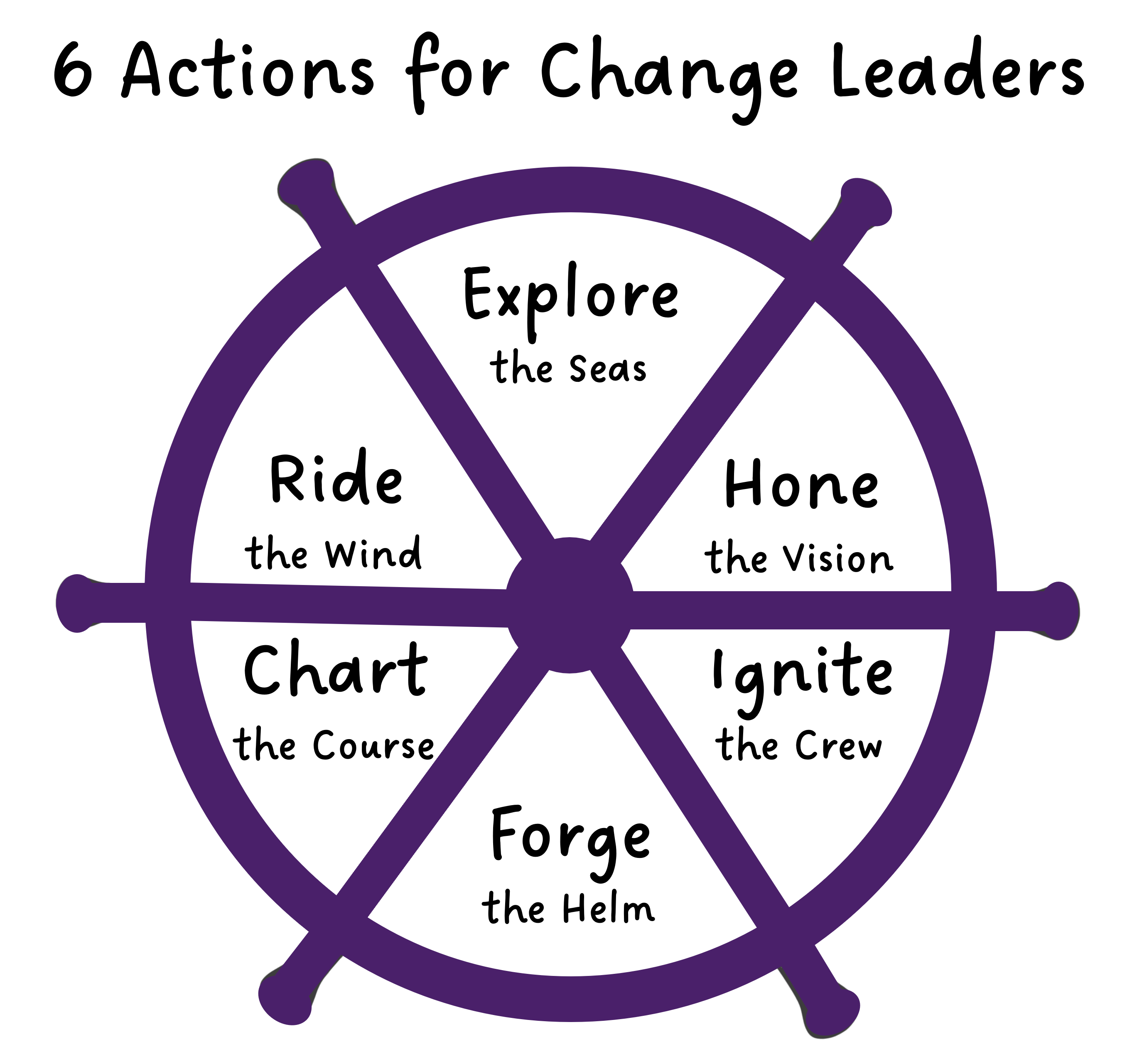
Explore the Seas: Get a sense of the core challenges, risks, and opportunities you’ll face. Consider what you need to learn or acquire to prepare yourself for success.
Hone the Vision: Define the inspiring destination that guides your journey and fuels your purpose. Clarify the “why” behind the transformation for your organization, your team, and yourself, ensuring everyone can see the value in reaching new shores.
Ignite the Crew: Channel your team’s energy and creativity into the journey. Foster a shared sense of purpose and replace anxiety with action and ownership.
Forge the Helm: Cultivate a strong foundation of trust and collaboration within your leadership team. Clarify direction, foster open communication, and create a unified approach to navigating the complexities of change.
Chart the Course: Lay out a practical and flexible map, ensuring clear milestones and a shared sense of direction. Avoid the pitfalls of uncertainty by engaging people in charting their journey.
Ride the Wind: Keep your team in motion with focus and momentum. Equip them to adapt as conditions shift, ensuring everyone stays connected and energized throughout the voyage.
This six-action approach will help you lead boldly and inspire your team. Using these six actions, you will be able to confidently navigate turbulent transformation, create clarity out of confusion, and avoid the mental exhaustion that so often accompanies constant change.
These six actions are not necessarily linear. They overlap, ebb, and flow throughout a transformation journey. However, to make it easier for you to understand and practice, we will explore each action one at a time in its own separate section of this book.
Let’s get curious and unpack the first action: Explore the Seas.